
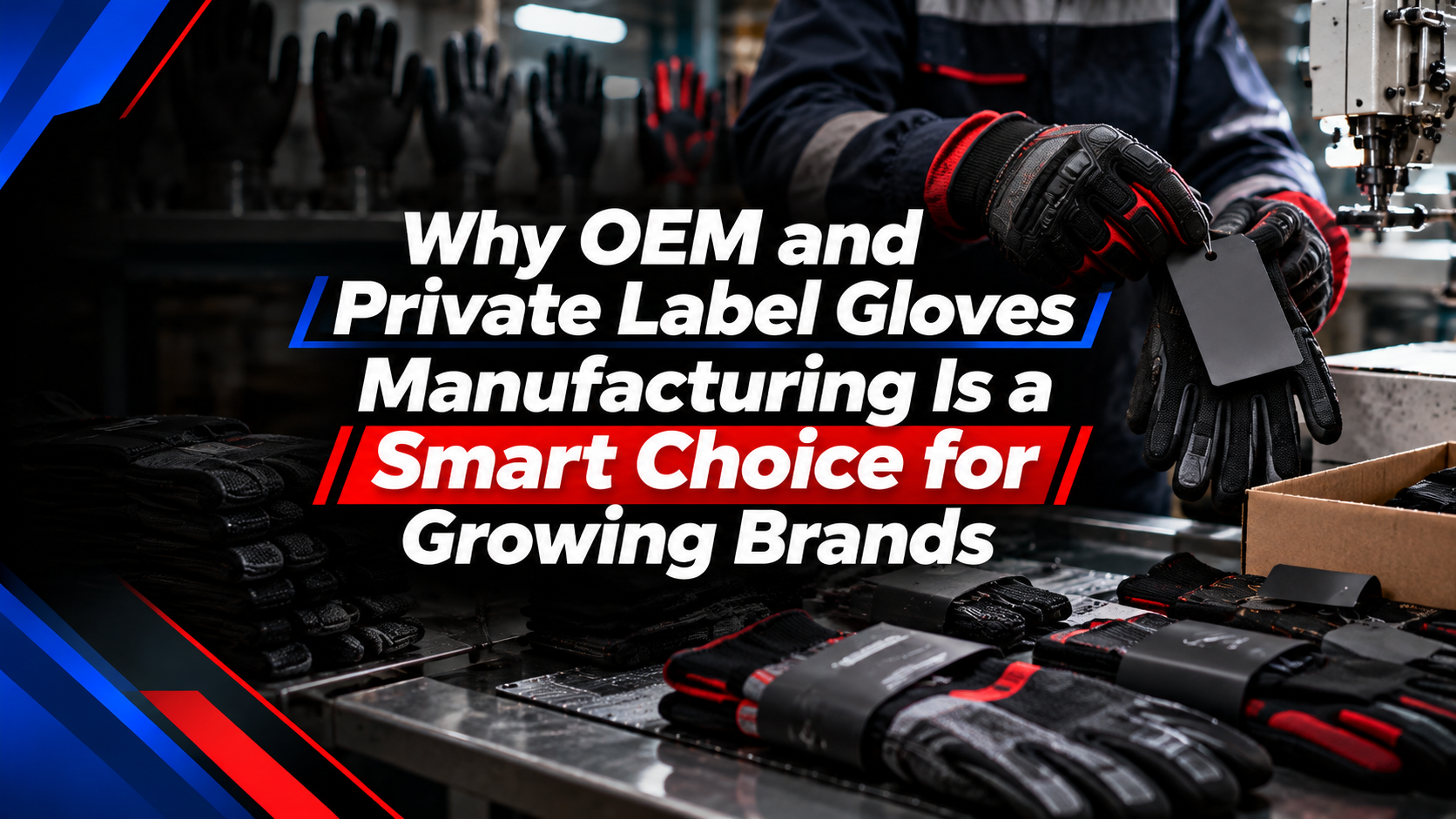
The global market for sports, safety, and professional gloves offers opportunities for businesses looking to establish recognizable product brands.
However, developing a glove collection requires more than an attractive design.
Businesses must consider material selection, product construction, sizing, comfort, branding, packaging, quality standards, and consistent production.
For many companies, building and operating their own manufacturing facility is not a practical starting point.
This is where OEM and private label gloves manufacturing becomes valuable.
By working with an experienced manufacturing partner, businesses can focus on brand development and customer relationships while coordinating product production through a specialized supplier.
At Sanjran Safety Sports, we focus on glove manufacturing solutions designed to support businesses that want customized products and brand-specific designs.
What Is OEM Gloves Manufacturing?
OEM stands for Original Equipment Manufacturer.
In glove manufacturing, OEM arrangements generally involve producing products according to agreed designs, specifications, or requirements for another business.
A buyer may specify:
- Glove style and intended application
- Material composition
- Product dimensions
- Stitching details
- Reinforcement locations
- Design and color combinations
- Branding requirements
- Packaging specifications
The manufacturer then develops or produces the glove according to the agreed requirements.
The exact development process depends on the complexity of the design and the manufacturing arrangement.
What Is Private Label Gloves Manufacturing?
Private label manufacturing allows a company to market products under its own brand name.
The products may be based on an existing design or an agreed customized version.
For example, a business may develop a collection of work gloves featuring its brand logo, packaging design, preferred colors, and product information.
This approach can help companies establish a consistent product identity.
Private label manufacturing is commonly relevant to:
- Sports equipment brands
- Industrial supply companies
- Workwear retailers
- E-commerce businesses
- Wholesale distributors
- Protective equipment suppliers
Although OEM and private label manufacturing are related, the terms are not always interchangeable.
OEM projects often involve more specific product-development requirements, while private label arrangements may use established product constructions with customized branding.
1. Build a Recognizable Brand Identity
Brand identity is an important part of selling gloves in competitive markets.
Customers often recognize products through colors, logos, packaging, and consistent design elements.
Private label manufacturing gives businesses greater control over how their products are presented.
Custom Logo Placement
Depending on the glove design, brands may choose logo applications such as:
- Printed logos
- Embroidered details
- Woven labels
- Rubber patches
- Embossed leather patches
- Custom packaging labels
The appropriate application method depends on the glove material and intended use.
Consistent Brand Colors
Businesses can develop collections with matching color combinations.
For example, a product range might use black and red across multiple glove styles to maintain a recognizable appearance.
Customized Packaging
Packaging helps communicate product identity and provides space for important product information.
Well-designed packaging can include:
- Brand name
- Product description
- Size information
- Material details
- Care instructions
- Applicable warnings
- Relevant compliance markings
Any certification or protective-performance claims should be accurate and appropriately substantiated.
2. Reduce the Need for In-House Manufacturing Infrastructure
Establishing a glove manufacturing operation can require significant resources.
Businesses may need cutting equipment, industrial sewing machines, specialized materials, skilled workers, production space, and quality inspection systems.
Using a third-party manufacturer can reduce the need to build all these capabilities internally.
This allows a brand to concentrate on other activities, including marketing, distribution, customer service, and sales.
However, outsourcing manufacturing does not eliminate the brand’s responsibility to manage product quality, regulatory compliance, and supplier relationships.
3. Access a Wider Range of Glove Designs
Different customers require different glove styles.
A manufacturer may support multiple product categories depending on its equipment, materials, and production capabilities.
Sports Gloves
Sports gloves can be designed for activities where grip, flexibility, and fit are important.
Examples include fitness gloves and certain training or sporting accessories.
Safety Gloves
Safety gloves are intended for workplace applications and may require specialized performance characteristics.
Any protective claims must be based on appropriate testing.
Leather Gloves
Leather gloves may be developed for general work, selected sports applications, or everyday professional use.
Industrial Work Gloves
Industrial gloves may incorporate durable materials, reinforced palms, flexible finger constructions, or specialized coatings.
By developing different glove styles, brands can build a wider product portfolio.
4. Customize Materials and Product Construction
Material customization is one of the key advantages of OEM manufacturing.
Different glove applications require different characteristics.
A business may prioritize:
- Flexibility
- Abrasion resistance
- Grip
- Breathability
- Comfortable lining
- Product weight
- Durability
- Visual appearance
Leather Material Options
Depending on the product, leather options may include cowhide, goatskin, or other suitable varieties.
Synthetic Material Options
Synthetic leather, textile fabrics, mesh panels, and specialized performance materials can support different designs.
Reinforced Construction
Brands may request additional reinforcement in selected product areas.
These may include the palm, fingertips, thumb, or other high-wear sections.
Every construction choice should be evaluated for its effect on function and comfort.
5. Support Product Differentiation
Businesses often want products that stand apart from standard market offerings.
OEM manufacturing creates opportunities to develop distinctive designs.
A brand might request:
- Unique color combinations
- Distinctive glove patterns
- Alternative cuff designs
- Personalized labels
- Specific material textures
- Adjustable fastening systems
- Different stitching appearances
These features can help create a recognizable product collection.
For safety gloves, aesthetic customization should never compromise required protective performance.
6. Improve Planning for Wholesale Product Collections
Wholesale brands need to consider consistency across their product lines.
A collection with coordinated designs, sizing, and packaging may be easier to present to distributors and retailers.
Private label manufacturing can support this approach by allowing product specifications to be documented and used across production orders.
Product Specification Sheets
A detailed specification sheet may include:
- Product dimensions
- Material composition
- Stitching requirements
- Color references
- Logo placement
- Label instructions
- Packaging specifications
- Quality acceptance criteria
Clear specifications help reduce misunderstandings during manufacturing.
7. Develop Long-Term Manufacturing Partnerships
A dependable supplier relationship can support product development over time.
As customer preferences change, businesses may need to adjust designs or introduce new glove styles.
A manufacturing partner can potentially support:
- Prototype development
- Material sourcing
- Sample revisions
- Production planning
- Product updates
- Packaging adjustments
Successful partnerships depend on clear communication, realistic timelines, and documented quality expectations.
Importance of Product Samples
Before approving a larger production order, businesses should review physical samples whenever practical.
Samples help buyers assess:
- Appearance
- Fit
- Material feel
- Stitching quality
- Branding placement
- Packaging presentation
Additional laboratory testing may be necessary for protective gloves.
8. Create Opportunities for International Business
OEM and private label manufacturing can support businesses selling products across different markets.
Importers, wholesalers, and distributors may require customized products for their respective customers.
However, international product distribution requires careful attention to regulations, labeling requirements, and product standards.
Requirements may differ between markets such as the European Union, the United States, and other regions.
Businesses should determine relevant obligations before placing products on the market.
The Custom Gloves Manufacturing Process
A well-organized manufacturing project generally includes several stages.
Step 1: Product Consultation
The customer communicates the intended application, design preferences, and required specifications.
Step 2: Material Selection
Suitable leather, textiles, reinforcements, linings, and other components are selected.
Step 3: Design Development
The product construction, dimensions, colors, and branding details are established.
Step 4: Sample Development
A sample is produced for evaluation.
Step 5: Sample Approval
The buyer reviews the sample and confirms any required adjustments.
Step 6: Production
Manufacturing begins according to approved specifications.
Step 7: Quality Inspection
Products are evaluated against the agreed quality requirements.
Step 8: Packaging and Dispatch
Approved products are packaged and prepared for shipment.
Actual procedures can vary according to the product, order size, and manufacturing arrangement.
Why Choose Sanjran Safety Sports for Custom Gloves?
At Sanjran Safety Sports, our business is centered on glove manufacturing and customized product solutions.
We understand that different brands have different requirements, from material preferences and sizing to labeling and product presentation.
Our goal is to support customers seeking tailored glove designs, OEM manufacturing, and private label opportunities.
We believe successful product development begins with clear specifications, careful material choices, and consistent attention to manufacturing details.